Why Should Businesses Write Blogs With AI? The Case Nobody Finishes Making
The honest case for why businesses should write blogs with AI: what it saves, what it costs, and where human editing still matters.

You've probably already tried this. You typed a topic into an AI tool, got a passable first draft back, spent an hour cleaning it up, published it, and waited. Maybe it ranked. Maybe it sat on page four next to eight other articles that all explain how to prompt the tool but never quite answer the question you actually searched: why should a business bother doing this at all, beyond saving a bit of time?
That's the gap. Most guides on this topic run through pros and cons like a spec sheet: efficient, scalable, data-driven, done. What they skip is the actual business argument: what changes for a company that builds AI into its content process compared to one that doesn't, and where the real risk sits if the balance is wrong.
The short version, before the detail:
- AI earns its place in the first draft and the research grind, not the final word.
- Any saving is real, but it moves. Time comes out of writing and goes into editing and fact checking, not out of the process entirely.
- The general guidance from search engines is that published quality matters more than how content was produced, which is not the same as saying unedited AI drafts rank. Unedited content of any origin tends to struggle.
- The businesses that benefit fastest are usually the ones already publishing consistently who simply can't keep the volume up with one writer.
- Brand voice, sensitive topics, and anything you'd stake your reputation on should stay human led, even when AI drafts the skeleton.
The business case nobody quite finishes making
Competitive necessity is the part most articles gesture at and then drop. A business publishing one blog post a month is building a very different search footprint to one publishing weekly, over the same six months, even before either post gets ranked. AI's real contribution to the business case isn't that it writes better than a person. It's that it removes the excuse of "we didn't have time" as the reason the blog went quiet for a quarter.
That's a growth argument, not a quality argument. If your content marketing has stalled because nobody in the business has three hours a week to write, AI closes that gap. If your content has stalled because nobody knows what to say, AI won't fix that, and no amount of prompting will.
Where AI actually earns its place
Across blog posts, content creation, content marketing and social media, the pattern is consistent: AI is strongest at the parts that are mechanical, and weakest at the parts that require judgement.
- Blog posts: outlines, first drafts, and restructuring a messy set of notes into something readable. This is where the time saving is biggest and the risk smallest, because a human still edits before anything goes live.
- Content creation more broadly: repurposing one long piece into shorter formats, drafting meta descriptions, generating variations of a headline to test.
- Content marketing: keeping a publishing calendar full when the bottleneck is capacity rather than ideas, and summarising research so a strategist can move faster.
- Social media: turning a finished blog post into three or four platform-specific posts, which is genuinely one of the more reliable uses because the source material (your own post) is already fact checked.
None of these hand the finished product to a machine. They hand it the mechanical bulk of the work, the parts that don't need judgement, not the finished piece.
Is it actually cheaper, or does the cost just move?
This is the honest answer most articles avoid: it depends on what you were paying for before. If you were paying a writer purely for typing speed, AI probably does cut cost, because a first draft that took a few hours can drop to well under an hour, depending on the topic and how much research it needs. If you were paying a writer for judgement, research, and a voice that sounds like your business, that cost doesn't disappear. It shows up again as editing time, fact checking time, and the time it takes to fix an SEO structure that reads fine to a person but confuses a search engine's understanding of the page.
So the fairer framing isn't "cheaper" or "not cheaper". It's that the cost shifts from creation to verification. A business that skips the verification step to bank the full saving is the one that ends up publishing something with a wrong figure, a broken internal link, or a claim nobody at the company actually checked.
How much editing before it's safe to publish under your name?
More than most people budget for on the first attempt. A workable minimum, before anything with your business name on it goes live:
- Every specific claim, number, or named fact gets traced back to a real source, not assumed to be correct because it reads confidently.
- At least one detail only your business would know gets added in, a real example, a specific process, a genuine opinion, so the piece isn't interchangeable with a competitor's.
- The opening and closing paragraphs get rewritten by a person, since these are where generic AI phrasing is most obvious to a reader.
- Someone checks it doesn't contradict something else already published on your site.
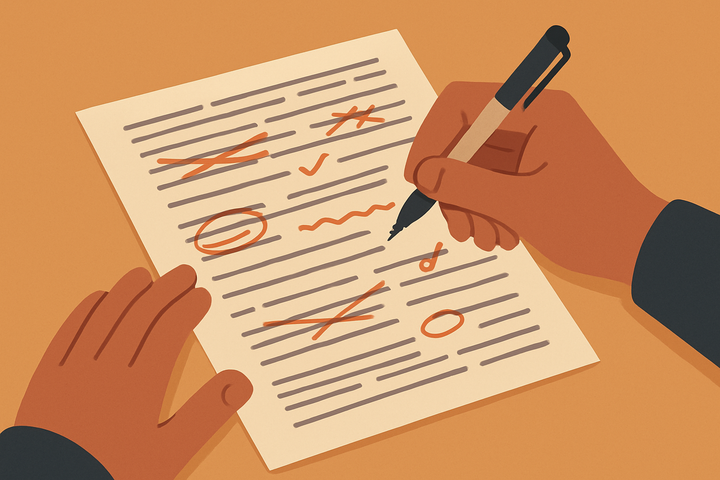
In practice, the fix is rarely a wrong fact. It's structural and tonal. Rewriting almost every paragraph because the phrasing simply wasn't right, cutting back an overuse of dashes and clipped short sentences that read nothing like how you'd actually write, and fixing capitalisation and punctuation choices no one would use in normal writing. Those are the edits that pile up, not the fact checking, once you actually sit down with a draft.
Before an AI draft goes anywhere near publish, it's worth checking whether every number in it traces back to something real, and whether the opening paragraph could have been written about any business in the industry rather than yours specifically. If either check fails, it isn't ready.
When does switching actually pay off?
The threshold isn't a tool or a price point, it's a publishing gap. If the business has been trying to post weekly and managing once a month, AI-assisted drafting closes that gap immediately and the payoff is close to immediate too. If the business posts consistently already and the problem is that the posts aren't converting or ranking, AI won't move that needle, because the constraint was never typing speed.
The other honest trigger is volume across channels. A business trying to keep a blog, a newsletter, and social media all fed from the same well of expertise benefits from AI stitching one piece of research into multiple formats. A business only doing one of those things has less to gain.
There isn't a tested figure here for minimum team size or posting frequency, and it would be dishonest to pretend otherwise. The honest position, at least for anyone still working this out on a smaller operation, is to stick close to what the search engines actually publish as guidance rather than assume a shortcut exists, and to adjust frequency as time allows rather than promising a fixed formula from day one.
Benefits and risks, stated plainly
Benefits: faster first drafts, easier to sustain a publishing schedule, good at summarising research, useful for repurposing existing content into other formats.
Risks: generic phrasing that reads like it belongs to no one, confident sounding errors that pass a first read, weaker SEO structure if published unedited, and a trust cost if a reader or client notices the piece sounds hollow. None of these risks are unique to AI. A rushed human draft has the same problems. AI just makes it faster to produce a rushed draft at scale, which is exactly why the editing step matters more, not less.
Which topics stay human
This is the part the bigger guides warn about without ever explaining. A practical split:
AI-assisted is fine for definitional content, how-to guides, roundups, and anything explaining a process that doesn't change often. Human-led, with AI only helping structure the piece, is the right call for anything involving a stated opinion, a sensitive topic affecting customers, thought leadership meant to build reputation, or any post making a claim specific to your business's results. The test is simple: if getting it wrong would embarrass the business or mislead a customer, a person writes it, and AI at most helps with the outline.
What happens if it's obviously AI written
Readers tend to notice generic phrasing and vague claims before they consciously register "this was written by AI". The trust cost comes from the writing feeling hollow, not from the production method itself. On the search side, the safer assumption is that thin, unedited content underperforms regardless of how it was produced, and that a well edited, fact checked post holds up whether a person or a tool wrote the first draft.
The stories nobody's telling you
Mine's the only one I can tell honestly, so here it is. When I started writing for my own blog with AI, the results were rough. I ended up with multiple posts effectively competing with each other for the same ground, and the tone of voice was completely off from how I actually write. Reading it back, none of it sounded like me. That's what forced the editing habit described above: nothing goes live from a draft now without a proper pass to check it against my own voice first.
The upside came once I fixed the process rather than dropped it. My personal blog went from almost no visibility, around 200 impressions a month, to over 5000 and still growing. That isn't a claim about hours saved per post or cost per article, I haven't tracked those precisely enough to put a number on them, but it's a real shift in visibility from the same site, using AI as part of the process rather than the whole of it.

Keeping it sounding like your business, not a tool
The gap between an AI draft and something that sounds like your business usually comes down to specifics. A tool doesn't know your actual process, your actual customers, or the thing you say differently to every competitor in your space. Feeding it examples of your own past writing helps, but the more reliable fix is the editing pass: read the draft and cut every sentence that could sit unchanged on a competitor's site. What's left is closer to your actual voice.
Will this still hold in six months?
Search engines change their guidance often enough that anyone promising a fixed formula is guessing. What's unlikely to change is the underlying principle: content that helps a real reader, backed by real detail, holds up better than content that doesn't, regardless of what wrote the first draft. The tactics around detection and formatting will keep shifting. The requirement to fact check, edit, and add something only your business could say is a safer bet to build a process around than any specific tool or workaround.
The honest answer to why a business should write blogs with AI isn't that it's cheaper or easier. It's that it removes the excuse for not publishing, and hands the actual writing judgement back to whoever's willing to do the editing properly.