How to keep brand voice consistent across multiple ai-written blog posts: a practical guide for people who have already tried
Learn a practical system for keeping brand voice consistent across multiple AI-written blog posts, from a one-page voice guide to real human review checks.

You've just published post number twelve. You open all twelve in separate tabs and read the closing paragraph of each one, back to back. Something feels off. Post three sounds warm, slightly cheeky. Post eight reads like a corporate whitepaper. Post eleven leans on "cutting-edge tailored solutions" twice in three sentences, a phrase your business has never once used out loud.
Nobody set out to write these wrong. They were all built from the same brief, using the same tool, and they still don't sound like the same business.
That's the actual problem with AI-written blog posts at scale. Getting one post to sound like you is easy. Getting the fortieth post to still sound like you, written by a tool with no memory of what "you" sounded like in post one, is a different job entirely.
Here's the shape of the fix, before the detail:
- Brand voice consistency means every post reads like it came from the same person, even though none of them were written by a person alone.
- It breaks down because AI tools default to confident, generic-sounding prose unless you actively correct for it, and that default shifts slightly every session.
- The fix is a short, specific voice guide, real writing samples fed back into the tool, and a human check on a schedule, not a one-off clever prompt.
- It has real limits. No guide fixes a lazy prompt, and no tool replaces someone reading the finished post before it goes out.
What "brand voice" actually means once AI is writing it
Brand voice is the personality behind the words: warm or clipped, plain or technical, whether it uses humour, whether it says "you" or "we". Tone is how that personality flexes per piece, so a launch announcement reads differently to a troubleshooting guide, even coming from the same voice. A style guide is simply the written record of both, so a tool, or a new hire, doesn't have to guess.
Most teams skip the style guide because writing one feels like homework. That's the mistake. Without it, every AI session is starting from a blank slate, and voice consistency across a growing content library depends entirely on whether whoever's prompting remembers to describe the voice the same way twice.
Build the one-page voice guide you'll actually use
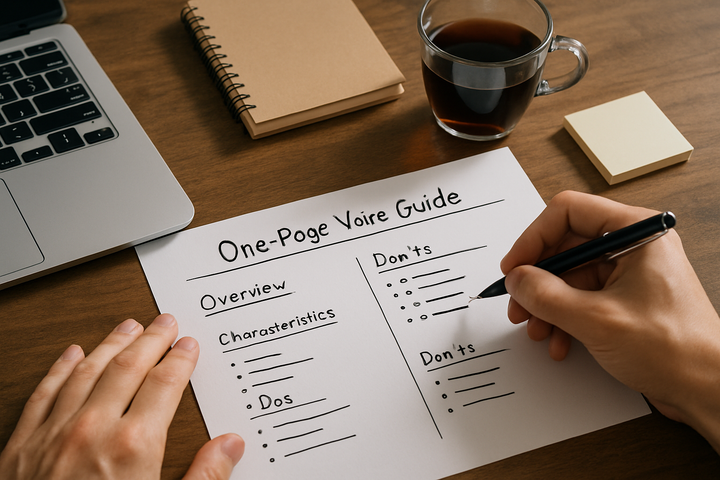
You don't need a brand book. You need one page that answers five questions:
- Three to five words that describe the personality (not "professional", something with actual texture: direct, dry, plain-spoken).
- Two sentences on what it isn't (this matters more than what it is).
- Typical sentence length and rhythm.
- A short list of words and phrases banned from the voice.
- One real paragraph, pulled from something you've already published, that shows the voice working.
Here's a prompt structure you can adapt instead of starting from a blank page:
"Write in the voice of [business name]. Our voice is [3-5 words]. We never sound like [what it isn't]. Sentences are short by default. We write to [audience] the way a tradesperson explains a quote to a mate, not the way a call centre script reads. Here's a paragraph in our voice: [paste one real paragraph]. Match that, not a generic version of professional."
A one-page prompt is enough to start, if you're the only person writing. It stops being enough the moment a second writer or a second AI tool joins in, which is the next problem.
| Step | Rough time | Rough cost |
| , - | , - | , - |
| Write the one-page voice guide | An afternoon | Free, it's your time |
| Feed the AI 3-5 old posts and turn the analysis into rules | 30-60 minutes | Free if you already pay for the AI tool |
| Add the guide to every prompt, every writer, every tool | A few minutes per post | Free |
| Audit a batch of already-published posts | An afternoon per 10-15 posts | Your time, or a freelance edit pass if you're short on it |
| Move to a dedicated brand voice tool | Half a day to set up | A monthly subscription, worth it once more than one person or tool is involved |
Feed the AI real examples, then check what comes back
The common advice is to feed three to five old posts into an AI tool and ask for a tone analysis. What most guides skip is what that analysis actually gives you, and what you're meant to do with it once you have it.
Ask it directly for something structured: recurring words, typical sentence length, common opening and closing patterns, and three things the voice never does. A useful output looks something like this:
- Recurring words: "honestly", "here's the thing", "look"
- Sentence length: short, rarely more than twenty words
- Structure: opens with a question or an admission, closes with a plain recommendation
- Never: exclamation marks, hedging, referring to the business as "we"
The mistake is stopping there. Analysis isn't a rule until you write it into the guide. Turn each line into an instruction, then feed that back into every future prompt.
Here's a rough example of the correction this produces. A typical AI-generic sentence: "Our team is committed to delivering exceptional value tailored to your needs." Run through a voice built on the pattern above, it becomes something closer to: "We fix the thing that's broken, and we'll tell you straight if we can't."
Same information, completely different person saying it.
How many posts before the voice starts drifting
There's no fixed number, whatever some tool's marketing page implies. It depends on how specific your guide is and how often you refresh the examples you're feeding it. A guide with three vague adjectives drifts by post five. A guide with a banned-word list and a real sample paragraph holds up much longer.
A habit that catches it early: read only the closing line of five posts in a row. If one of them doesn't sound like something you'd actually say out loud to a customer, that's the drift alarm going off before you've got fifty posts to fix instead of one.
Multiple writers, multiple AI tools, one voice
If your team has different people using ChatGPT, Claude, and Jasper on the same content calendar, you don't have one voice problem, you have three. Each tool defaults to its own version of "generic professional" if left unguided, and each writer interprets "casual but professional" slightly differently.
The fix isn't picking one tool. It's making the guide the shared source of truth, not something each writer keeps in their head. Paste the same voice snapshot paragraph into every prompt, regardless of which tool it's going into. Review a sample from each writer against the guide on a schedule, not just when something sounds off.

Catching a batch of posts that already went out sounding wrong
You don't need to rewrite everything. Pull up the last fifteen or twenty posts and skim just the openings and closings, since that's where generic AI phrasing shows up hardest. Fix the worst offenders first: the ones using banned phrases, the ones with no personality at all. Leave the middle-ground posts alone.
From here, apply the guide to everything new, and quietly rework older posts as you go rather than pausing to mass-edit. A perfectly consistent archive matters less than a improving one.
The Australian phrasing AI keeps defaulting to
Most AI tools are trained on overwhelmingly American content, and it shows. Watch for American spelling sneaking through (color, organize, favor), American date formats, and American idiom (vacation instead of holiday, "reach out" doing a lot of heavy lifting). None of this is a voice problem exactly, but it reads as off to an Australian audience just as fast as the wrong tone does.
Add "Australian English, en-AU spelling, no American idiom" to your standing prompt, and check the first paragraph of every draft for it specifically. It's a small thing that gets missed constantly because it doesn't feel like a voice issue until a reader notices it isn't.
Quantifying tone doesn't help unless you can check it
"80% casual, 20% formal" sounds precise, as of August 2026. It isn't checkable against a paragraph of text, which makes it useless as a working rule. Nobody, including the AI, can measure a percentage split in prose.
Replace it with specifics: casual means contractions, short sentences, second person. Formal creeping in looks like passive voice, jargon, or "utilising" instead of "using". Check each draft against that list line by line, not against a ratio.
Keeping the voice steady across social media too
The same voice guide should feed your social captions, not just blog posts. The tone can flex per channel (shorter, more direct, more of a call to action on social) while the underlying personality and the banned-words list stay identical. If your blog sounds dry and plain-spoken but your Instagram captions sound bubbly and exclamation-heavy, that's the same inconsistency problem showing up on a second channel.
When it's worth paying for a dedicated brand voice tool
If you're one person writing occasionally, sharper prompts in whatever AI tool you already pay for will get you most of the way there. Following the guide above typically won't cost you anything beyond the time you put into it.
The maths changes once more than one person, or more than one tool, is producing content regularly. That's when a dedicated setup, like blogwriting.ai, earns its subscription: the voice guide lives in one place, feeds the research and the writing and the publishing step, and doesn't rely on every writer remembering to paste it in manually.

Where this still breaks down
AI still defaults to generic the moment your prompt is vague, no matter how good your guide is. The guide itself goes stale as your messaging evolves, so it needs revisiting every few months, not written once and forgotten. And no guide or tool replaces a human reading the final draft before it publishes, especially the closing paragraph, which is where the voice slips first and gets noticed last.
Key takeaways
- Write a one-page voice guide with real examples, not adjectives alone.
- Turn every AI tone analysis into a written rule, not just a read-and-forget report.
- Share the same guide across every writer and every AI tool on your team.
- Audit old posts in passes, fixing openings and closings first, not a full rewrite.
- Check for Australian spelling and idiom specifically, it drifts as easily as tone does.
- Revisit the guide every few months. It's a living document, not a one-off setup.