How to write blog titles and headings that match your natural brand voice instead of AI?
Learn why AI generated titles sound generic and how to build a voice reference so your blog titles and headings sound like you, not a template.

The first time I typed "give me ten blog title ideas" into an AI tool, every single one technically worked. Correct grammar, the right keyword sitting near the front, sensible length for a search snippet. Not one of them sounded like something I would put my own name under.
That gap between "technically fine" and "sounds like me" is what this article is about, and here's the trade-off nobody puts in the opening paragraph: an AI-generated title is faster than a voice-matched one, every single time, at least on the first draft. You pay that time back later, either by hand-editing every title before it goes live, or by building a proper voice reference once so you stop having to fix the same problem post after post. Both are legitimate choices. Pretending there's a free option isn't.
Why every AI-generated title reads the same
Large language models (the systems behind tools like ChatGPT, Claude and Gemini) are trained on enormous volumes of existing text and, when asked for a title, default to whatever phrasing shows up most often in that training data. That's not a flaw, it's the mechanism working as designed. It's also why you keep seeing the same shapes: "The Ultimate Guide to X", a colon followed by a generic subtitle, a number stacked at the front of the sentence, a rhetorical question as the opener.
None of those structures are wrong. They're just average. And average is precisely what a blog post title can't afford to be, because a title's entire job is to stand out in a list of other titles competing for the same click.
Work out your natural voice before you touch a single title
You can't match a voice you haven't actually defined. Before you write or rewrite a single heading, pull five to ten sentences you've genuinely said or written elsewhere: an email to a client, a caption you posted, notes from a phone call. Read them back and ask three questions. What length are your sentences usually? Do you ask things or state them? Is there a word you'd never say out loud that keeps turning up in your drafts anyway?
Turn the answers into a one-page style guide: three adjectives that describe how you sound, five words you're banning from your own titles, and one example title you'd actually publish next to one you'd reject. It takes less time than it sounds and it's the single most useful document you'll build for this.
If you run a small business blog out of Australia, add one more line to that guide: write the way you'd talk to a customer at the counter, not the way a template built for the American SEO market talks. Most AI defaults skew towards that louder, hyped-up US tone. Read your draft title out loud in your own accent before you publish it. If it sounds like it was translated from somewhere else, it probably was.

Let AI do the research, not the talking
You don't have to give up AI entirely to keep your voice. Keyword research, competitor title structures and search intent are exactly the kind of grunt work AI tools are good at, because none of that output goes live as written. Ask the tool what people are actually searching for around your topic, what title formats keep showing up for it, and where the gaps are. Then close the tab and write the actual title yourself, in your own words, using that research as raw material rather than a finished product.
The robotic tone shows up when people skip the second half of that process and publish whatever the tool handed back. The research isn't the problem. Publishing the research's exact wording is.
A three-step rewrite: turning an AI draft into something you'd actually publish
Once you've got an AI draft in front of you, the fix isn't a full rewrite from scratch. It's usually three moves.
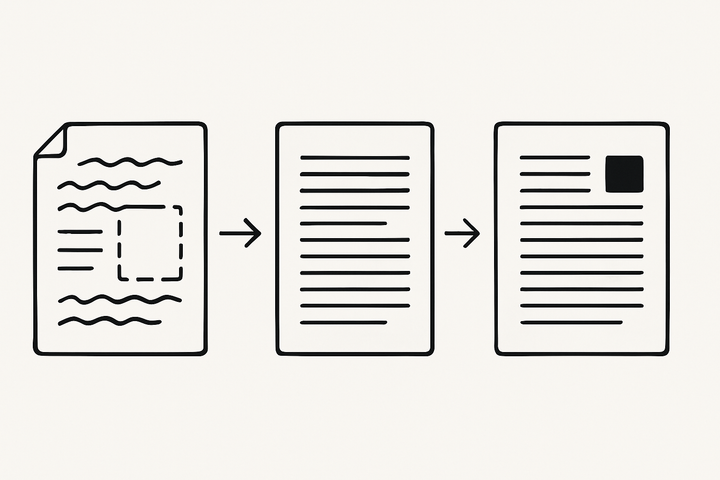
First, replace the generic adjective with a specific outcome. Second, cut any word from your banned list. Third, decide on purpose whether the title should be in Title Case or plain sentence case, because that choice alone changes how formal a heading feels, and it should match the voice guide you built earlier, not the tool's default setting.
| AI draft | Rewritten in brand voice | What changed |
|---|---|---|
| 10 Essential Tips for Choosing the Right Locksmith Every Time | How to pick a locksmith you won't have to call twice | Swapped the vague "essential" for a specific, slightly wry outcome |
| The Ultimate Guide to Physiotherapy for Back Pain | What actually helps a bad back, and what's just marketing | Dropped "Ultimate Guide", added an honest second half |
| Unlock the Secrets to Better Customer Reviews | Why your customers aren't leaving reviews (and what to say instead) | Cut "unlock" and "secrets", replaced with a real, specific problem |
Notice none of these are longer or cleverer. They're just specific to a real business rather than to businesses in general.
Six tells that give away an AI-written title (and how to fix them)
Some patterns are worth checking your own drafts against directly:
- Hype verbs: unlock, elevate, revolutionise, supercharge. Replace with the plain verb you'd actually use.
- Stacked adjectives: "the ultimate, complete, essential guide". Pick one, or none.
- Colon plus generic subtitle: "X: Everything You Need to Know". Ask what the post actually adds that a search engine result page doesn't already tell you.
- Numbers with no reason: "7 Ways to..." when the post doesn't actually have seven distinct points. If you didn't count them, don't claim a number.
- Rhetorical question openers on every single heading: one question in a piece lands. Five in a row reads like a template.
- Inconsistent or oddly formal capitalisation and punctuation: Title Case applied halfway through a sentence, or stray em dashes dropped in where a comma would sit more naturally in how you actually talk. If your headings suddenly look more "corporate" than your emails do, that's usually the tell.
If more than two of those show up in a draft, it's worth a rewrite before it goes anywhere near the publish button.
Do headings follow different rules to body copy?
Slightly, yes. A blog post title has to carry personality because it's the thing competing against ten other results in a search page or a social feed. Subheadings inside the post have a different job: they're there so a skimming reader can find the section they actually want, so clarity beats cleverness there. That said, "AI-flat" subheadings, single generic words like "Overview" or "Conclusion" when you'd never say either of those out loud, are still worth fixing. Even technical writing, where precision matters more than personality, benefits from headings that sound like a person wrote them rather than a template generator.
Keeping the same voice across fifty posts without redoing the work each time
Here's the sticking point most people hit. The first rewritten title feels great. By post twenty, re-explaining your voice to an AI tool every single time, or manually checking every heading against your one-page guide, starts costing more time than it saves.
I did use ChatGPT to write me a number of blogs before we started to develop blogwrting.ai and boy was I off the mark by a mile. I had inconsistent titles, headings subheadings each article felt like it was written by a different writer.
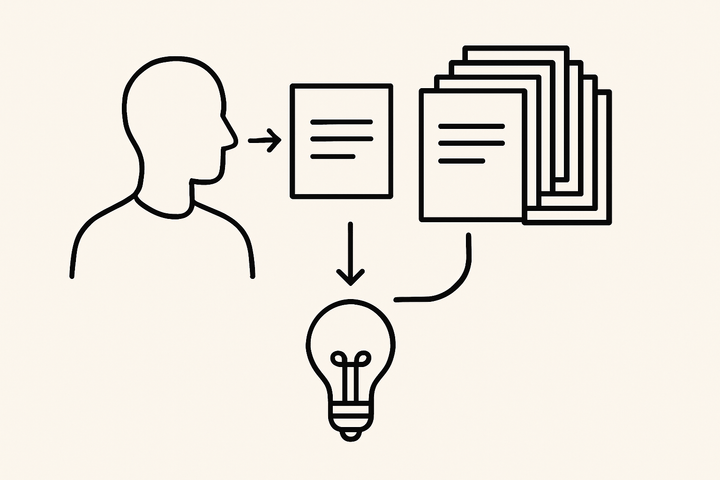
This is the actual argument for building a reusable writing profile rather than re-prompting "sound more like me" from scratch each time. A writing profile, the kind BlogWriting.ai builds from real writing samples, is a saved reference covering your voice, your narrator style, your formality register, your reader's likely mindset, your English variant, and your banned words and phrases. You set it up once, properly, the way you'd set up the one-page style guide above, and every title and heading generated afterwards is checked against it automatically, instead of you checking it by hand every time.
Key takeaways
- AI titles read the same because the models default to the statistically safest phrasing, not because they're broken.
- Define your voice from real sentences you've written before you touch a title, not from a mood board.
- Use AI for keyword research and structure, then write the actual words yourself.
- Rewrite AI drafts with three moves: specific outcome instead of a generic adjective, banned words cut, and a deliberate capitalisation choice.
- Watch for hype verbs, stacked adjectives, colon-plus-subtitle formulas, false numbers, repeated rhetorical questions and inconsistent capitalisation.
- Titles carry more personality weight than subheadings, but neither should sound like a template.
- A one-off voice guide works for a handful of posts. A reusable writing profile is what keeps the voice consistent once you're past post twenty.